

Wedding Catering Packages That Fit Every Style and Budget

Last Updated: October 25, 2026
Quick Summary
Wedding catering packages come in four main styles, full-service, buffet, attended, and drop-off, each offering different levels of staffing, setup, and service to match your celebration style and budget.
Full-service catering includes staff, linens, setup, and cleanup, best for formal weddings with 100+ guests.
Buffet service lets guests serve themselves with minimal staff, suited for casual outdoor events.
Attended catering features roaming servers with passed appetizers, costing between buffet and full-service.
Drop-off catering is the most budget-friendly option, requiring you to handle service and cleanup yourself.
Table of Contents
Wedding Catering Packages Explained
Full-Service Catering
Buffet Service
Attended Catering
Drop-Off Catering
Quick Catering Package Comparison
Wedding Catering Cost Per Person and Budget Planning
What actually drives the per-person price
Sample budget scenarios
The inclusion checklist
Build your budget in three tiers
Where couples commonly overspend
Wedding Catering Menu Ideas for Every Celebration
American Cuisine and Regional Favorites
Italian and Mediterranean Options
Barbecue and Casual Celebrations
Key Questions to Ask Your Wedding Caterer
Venue and logistics questions
Contract and booking timeline questions
Service and staffing questions
Dietary and menu questions
References and proof questions
A simple booking timeline
How to Compare Wedding Catering Quotes
Dietary Accommodations and Allergen Management
Getting Your Custom Catering Quote
Frequently Asked Questions
Wedding Catering Packages Explained
Wedding catering packages come in distinct styles, each with its own staffing needs and guest experience. Understanding these models helps you match your vision to what works logistically and budgetwise.
The four main types, full-service, buffet, attended, and drop-off, each solve different problems, shaping how guests eat, how long service takes, and how much you pay for labor versus food.
Full-Service Catering
Full-service catering means the caterer owns the entire experience: arriving early, setting up, serving, managing the bar, clearing plates, and leaving with everything cleaned. Your job is to show up and celebrate.
This package includes staffing, linens, serving ware, setup, and breakdown. The caterer coordinates timing with your venue and photographer and handles last-minute guest count changes, dietary swaps, and service flow.
Full-service works best for formal weddings, large guest counts (100+), and events where you want seamless, polished service. Check what Something Classic offers for full-service wedding catering to see how customization and service quality align with your vision.
Buffet Service
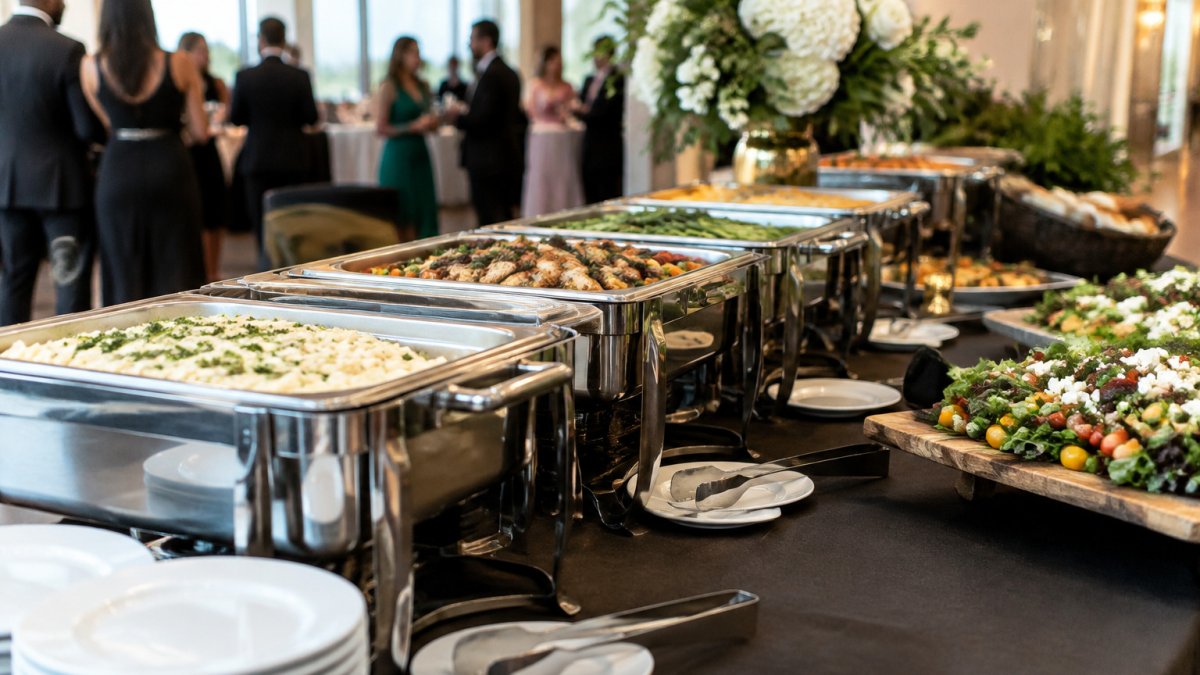
Buffet catering positions food on tables and lets guests serve themselves, though the caterer still provides staff to replenish dishes and clear plates. You save on plating labor, but guests experience less formal dining.
Buffet works well for casual celebrations and outdoor events where mingling matters more than seated formality.
This style suits barbecue, family-style Italian, and casual American menus.
Attended Catering
Attended catering means staff circulates with food and drinks, passed appetizers, wine service, creating an elevated, interactive experience without full plated-dinner formality.
Attended service requires more trained staff but delivers high perceived value: guests feel pampered, and the caterer controls portions and dietary needs precisely. It suits cocktail receptions and upscale casual events.
The cost sits between buffet and full-service plated dinners.
Drop-Off Catering
Drop-off catering means the caterer delivers prepared food, sets it out, and leaves. You or your venue handle service and cleanup, the most budget-friendly option.
Drop-off works if you have a capable venue team, family helpers, or a small guest count. The caterer provides food in serving vessels; you manage the rest.
It requires more from your side, and it's popular for rehearsal dinners and casual celebrations.
Quick Catering Package Comparison
Service Style | Staff Included | Setup & Cleanup | Best For | Cost Level |
Full-Service | Yes, full team | Included | Formal weddings, 100+ guests | Premium |
Buffet | Minimal staff | Partial | Casual events, outdoor | Mid-range |
Attended | Roaming servers | Minimal | Cocktail receptions, upscale casual | Mid-range to premium |
Drop-Off | None | None | Small events, DIY service | Budget-friendly |
Wedding Catering Cost Per Person and Budget Planning
Wedding catering pricing is a stack of line items: the per-person figure sums food cost, labor, rentals, and service fees. Learn Charlotte-specific pricing and budget planning strategies to understand what you'll actually pay for your wedding. Understanding that stack is the difference between comparing quotes intelligently and guessing.
What actually drives the per-person price
Five variables move the number more than anything else:
Service style. Drop-off is the lowest labor tier; full-service plated is the highest.
Menu tier and proteins. Chicken and pasta sit at the low end; beef tenderloin, lamb, and seafood stations push the number up. Passed hors d'oeuvres add per-piece cost.
Guest count. Larger counts spread fixed costs (travel, setup, kitchen prep), so the per-person rate often drops as the count rises.
Sample budget scenarios
Use these as planning anchors, not quotes; actual pricing depends on menu, date, venue, and guest count.
Guest Count | Service Style | Menu Tier |
|
|
50 | Drop-off | Simple |
|
|
50 | Buffet | Mid | $30-$45 |
|
100 | Buffet | Mid | $30-$45 |
|
100 | Full-service plated | Premium | $65-$95+ |
|
150 | Full-service plated | Premium | $65-$95+ |
|
200 | Attended / stations | Mid to premium |
|
|
Always confirm what's inside a quote before comparing.
The inclusion checklist
Run both quotes through the same checklist before comparing per-person prices, a higher quote may include more.
Food and menu items
Service staff (servers, bartenders, captains)
Setup and breakdown
Itemize before you decide.
Build your budget in three tiers
Set three numbers before you request quotes:
Target budget. What you would like to spend.
Stretch budget. What you could spend if the right caterer and menu appear.
Walk-away number. The ceiling you will not cross.
Share the target and stretch with your caterer; good ones will show where the menu can flex without gutting the experience.
Pro Tip Ask every caterer to quote the same guest count, date, service style, and menu outline. Apples-to-apples quotes are the only way to compare real value.
Where couples commonly overspend
Adding stations without cutting elsewhere. Each station adds labor, equipment, and food cost. Balance stations against plated courses.
Underestimating the bar. Set a cap or choose a signature cocktail plus wine and beer.
Forgetting service charge and tax. These can add a meaningful percentage on top of the food and labor subtotal.
A realistic budget isn't the lowest per-person number, it's the number that covers what you actually want.
Wedding Catering Menu Ideas for Every Celebration
Your menu sets the tone for the entire event. The best menus match your style, your guests' tastes, and the season. They also work logistically, food that travels well matters for attended service; food that holds temperature matters for buffet.

American Cuisine and Regional Favorites
American wedding menus range from classic steakhouse fare to regional specialties. Prime rib, herb-roasted chicken, and seasonal vegetables are familiar, reliable standbys that work for most guests.
Regional American cuisine adds character, Southern comfort food, New England clam bakes, Midwest farm-to-table, and often feels more personal than generic hotel fare.
American menus work across all service styles: straightforward to plate, easy to keep warm, and simple to reheat.
Italian and Mediterranean Options
Italian and Mediterranean menus bring elegance without formality, pasta courses, risotto, fresh seafood, and olive oil-forward sides. They work beautifully for buffet service, since guests can see and choose what appeals, and pasta holds temperature well.
Barbecue and Casual Celebrations
Barbecue weddings have moved from backyard informal to stylish celebration. Smoked brisket, pulled pork, and house-made sides create a relaxed, generous feel. Barbecue works best for outdoor events, afternoon celebrations, and couples who want their personality front and center. It's inherently casual but can be plated elegantly. Explore how Something Classic approaches stylish barbecue wedding ideas to see how rustic food becomes refined celebration.
Key Questions to Ask Your Wedding Caterer
Most caterer questionnaires stop at "what's included" and "do you handle dietary restrictions." Those matter, but they don't tell you whether the caterer can execute at your venue, on your date, under your contract terms.
Venue and logistics questions
What is your delivery radius, and what are the travel fees? Confirm whether your venue falls inside the standard radius or triggers a mileage charge.
Have you worked at this venue before? A caterer who knows the loading dock, kitchen access, elevator restrictions, and noise rules will save you headaches.
What are the venue's catering rules? Some venues require licensed and insured caterers, restrict open flames, limit setup times, or mandate specific cleanup. Ask the caterer to confirm they meet those requirements.
Contract and booking timeline questions
When is the deposit due, and how much is it? A common pattern is a percentage of the estimated total at signing, with the balance due before the event.
When is the final guest count due? Most contracts set a deadline, often one to two weeks out. Ask what happens if your count changes after that date.
What is the cancellation and postponement policy? Understand refunds, credits, and date-change fees before you sign.
Service and staffing questions
How many servers and bartenders will be on site? Ask for the ratio, not just a headcount.
Who is the on-site captain or event lead? You want a named point of contact for the day.
How do you handle a guest with a severe allergy during service? Ask about labeling, separate prep, and server communication.
Dietary and menu questions
Can you accommodate vegetarian, vegan, gluten-free, and allergy-aware guests? Ask for examples, not assurances.
How do you prevent cross-contamination? Separate surfaces, utensils, and fryers matter for severe allergies.
Can we customize the menu, and does customization change the price? Some caterers allow swaps within a tier; others charge for changes.
References and proof questions
Can you share references from weddings similar in size, style, and venue to ours? Call them. Ask what went well and what they would change.
Can we see photos or a sample timeline from a recent event? Real examples beat a portfolio of styled shoots.
Watch Out Do not sign a contract until you have confirmed the deposit amount, the final guest-count deadline, the cancellation terms, and exactly what the quote includes.
A simple booking timeline
A common planning sequence looks like this:
12 to 18 months out: Research caterers, request quotes, and book your top choice.
6 to 9 months out: Schedule a tasting and lock the menu direction.
2 to 3 months out: Confirm rentals, bar plan, and service style details.
2 to 4 weeks out: Submit final guest count and dietary list.
1 week out: Confirm timeline, venue access, and on-site contact.
Timelines vary by caterer and season, so confirm each milestone in your contract. Answer your common catering questions before requesting a quote so you walk into the conversation with the right details.
How to Compare Wedding Catering Quotes
Comparing quotes means looking past the per-person number to what's actually included. Request quotes from at least three caterers using the same specifications: guest count, date, service style, and menu outline. Break down each quote: food cost, service staff cost, and what's included in setup and cleanup. Itemized quotes are easier to compare. Ask about flexibility, swapping menu items, reducing guest count without penalty, moving the date, since flexibility costs money but matters if plans shift.
Dietary Accommodations and Allergen Management
Dietary restrictions are non-negotiable. Your caterer must handle them correctly or your event fails for those guests. Ask how the caterer manages cross-contamination, for severe allergies (shellfish, nuts, soy), separate prep surfaces and utensils matter. Get detailed guidance on vegan, gluten-free, and allergy accommodations. Discuss your specific restrictions upfront: vegan weddings need protein-forward vegetable dishes and dairy-free desserts, gluten-free guests need certified gluten-free options, and shellfish allergies require kitchens that don't prep shellfish in shared areas.
Getting Your Custom Catering Quote
When you're ready to move forward, a custom quote starts with specifics. Gather these details before reaching out: date, guest count, service style, venue, any dietary restrictions, and your menu preferences.
The right catering package matches your wedding style, your budget, and your vision for how you want guests to experience your day. Whether you choose full-service elegance, casual buffet, attended sophistication, or drop-off simplicity, clarity about what's included and what you're paying for prevents surprises.
Frequently Asked Questions
How much does wedding catering cost per person?
Wedding catering cost per person varies widely based on service level and menu selections. Pricing depends on guest count, menu complexity, venue location, and service staff requirements. Request a custom quote to get accurate pricing for your specific event.
What questions should you ask a wedding caterer before booking?
Ask about what's included in each package (staff, rentals, setup, cleanup), their experience with your venue, menu customization options, how they handle dietary restrictions and allergens, cancellation policies, payment terms, and their timeline for tastings and final planning meetings. Request references from recent weddings and clarify whether prices are per-person or flat fees. Understanding these details upfront prevents surprises and ensures your caterer can deliver the experience you envision.
What is usually included in a wedding catering package?
Full-service packages typically include food preparation, service staff, table setup, linens, dishware, and cleanup. Attended catering adds staff to manage the flow and service throughout your event. Buffet service includes food and basic setup but may have limited staff. Drop-off catering provides prepared food only, you handle serving and cleanup. Always confirm what rentals, beverages, desserts, and bar service are included in your quoted price, as these details vary significantly between caterers.
Can wedding catering packages accommodate dietary restrictions and allergens?
Professional catering companies can accommodate multiple dietary restrictions including celiac disease, shellfish allergies, vegetarian, vegan, and other allergies with proper planning. The key is communicating all dietary needs clearly during your initial consultation and confirming that your caterer has protocols to prevent cross-contamination. Discuss how they source ingredients, prepare separate dishes, and train staff to handle allergen concerns.
Contact Us
Add somethingclassic.com as a preferred source on Google →


basketball stars online benefits from giving players different ways to approach scoring situations. Sometimes an aggressive shot is worth attempting, while other moments call for patience and better positioning. This flexibility prevents offensive play from becoming repetitive and encourages users to experiment with different approaches. Every match becomes an opportunity to discover which decisions work best against a particular opponent.