

Farm-to-Table Catering Benefits: A 2026 Guide

Table of Contents
What Farm-to-Table Catering Actually Means
The Core Benefits of Farm-to-Table Catering
Freshness and Peak Ripeness
Superior Flavor and Food Quality
Nutritional Value and Ingredient Traceability
Environmental and Community Impact
What the environmental benefit actually comes from
How to assess the impact without overstating it
The community and economic side
Limitations worth naming
Seasonal Wedding Menu Ideas and Planning
Farm-to-Table Menu Planning for Corporate and Private Events
Locally Sourced Catering: Building Farmer Partnerships
Sustainable Catering Practices and Operational Realities
Addressing Cost and Practical Concerns
What actually drives the price
Making it work at different budgets
The practical concerns, addressed directly
The bottom line on cost
Frequently Asked Questions
Last Updated: October 21, 2026
What Farm-to-Table Catering Actually Means
Farm-to-table catering means sourcing ingredients directly from local farms and regional producers, then preparing and serving them with minimal time between harvest and plate, prioritizing freshness, traceability, and seasonal availability, the core farm-to-table catering benefits that define the approach. At Something Classic, we've built our practice around this principle for over three decades, growing our own herbs, edible flowers, and specialty produce while partnering with regional farmers who share our commitment to quality.
The Core Benefits of Farm-to-Table Catering
Freshness and Peak Ripeness
Ingredients harvested within days of service arrive at peak ripeness, a direct consequence of compressed supply chains. Tomatoes traveling 1,500 miles are picked underripe to survive the journey; those from a farm 20 miles away are harvested at maturity.
According to USDA Economic Research Service research on local food systems, local and regional food systems keep ingredients fresher by reducing transportation time and storage duration.
Superior Flavor and Food Quality
Peak ripeness translates to flavor: ripe fruit has higher sugar content and more developed aromatics, and vegetables harvested at maturity taste deeper and more nuanced.
This is where farm-to-table catering benefits separate from standard approaches: a chef working with fresh, seasonal ingredients doesn't need heavy sauces to compensate. At Something Classic, our culinary team designs menus around what's at its best right now.
Nutritional Value and Ingredient Traceability
Fresh ingredients retain more nutrients. Research from Sustainable Agriculture Research and Education (SARE) on farm-to-table benefits indicates that locally sourced, freshly harvested produce maintains higher nutrient density compared to ingredients that have traveled through extended supply chains.
Traceability matters equally. With farm-to-table sourcing, you can identify the specific farm, the growing practices, and often the farmer's name. Cross-contamination risks drop when you work with known producers using documented practices.
For guests with celiac disease, shellfish allergies, or other serious restrictions, this is invaluable: you're not relying on a supplier's supplier's documentation but verifying handling practices firsthand.
Environmental and Community Impact
Most farm-to-table articles stop at "fewer food miles, support local farms." That's true but not useful to an event planner deciding whether the claim holds up for a specific menu. The honest framing separates what farm-to-table catering reliably delivers from what it only sometimes delivers.
What the environmental benefit actually comes from
Three mechanisms drive most of the environmental difference in catering:
Transport distance and mode. A tomato trucked across the country travels roughly 1,500 miles; one from a farm 20 miles away travels a fraction of that. Savings are real but modest per ingredient, and shrink with heated greenhouses or multiple small delivery runs. The benefit is largest for produce that would otherwise be cold-chained long distances.
Seasonality instead of controlled-environment growing. A seasonal menu avoids the energy load of out-of-season production, usually a bigger lever than food miles, and one most caterers control through menu design.
Lower-input production on many small farms. Smaller regional producers often use fewer synthetic inputs and more diversified cropping, though this varies widely and shouldn't be assumed. Ask, don't assume.
The environmental case is strongest when the menu is seasonal, the sourcing radius is genuinely short, and deliveries are consolidated; it weakens when "local" means a 300-mile radius or out-of-season items come from heated greenhouses.
How to assess the impact without overstating it
You don't need a life-cycle assessment to sanity-check a caterer's claims. Ask:
What's the sourcing radius? "Local" is undefined in law and marketing. Ask for a mileage band (e.g., within 100 miles, within the state) and how much of a given menu falls inside it.
How seasonal is the menu? Ask what percentage of the proposed menu is in season at the event date. A high number is a better environmental signal than a vague local claim.
How are deliveries consolidated? One consolidated run from a regional hub beats five separate farm pickups.
What happens to surplus? Ask about donation, composting, and trim utilization. Food waste often outweighs transport emissions in catering.
Is there any documentation? Some producers hold third-party certifications (USDA Organic, Certified Naturally Grown, or state-level programs). Certifications aren't required for farm-to-table, but they're verifiable.
Pro Tip Treat "local" as a question, not a claim. A caterer who can tell you the farm name, the distance, and what's in season on your date is giving you something you can evaluate. A caterer who can only say "we source locally" is giving you a slogan.
The community and economic side
The community benefit is more straightforward: money spent with regional producers tends to stay in the region, and direct relationships give farmers a predictable customer.
But be careful with scale: a single event's purchasing is small relative to a farm's total revenue. Impact compounds when a caterer buys consistently across a season, so ask how much of annual purchasing goes to regional producers.
Limitations worth naming
The environmental and community case has real limits, and a balanced guide should say so:
Seasonality constrains the menu. You cannot get the same dish in January that you served in July, and forcing it usually means sourcing from far away or from controlled environments, which erodes the benefit.
Small farms have smaller volumes. A 300-guest event may exceed what a single regional farm can supply for a given crop, requiring multiple suppliers or a blend of local and regional sourcing.
Weather and yield risk. A late frost or a wet harvest can wipe out a planned ingredient. Farm-to-table caterers need backup suppliers and menu flexibility, and clients should expect substitutions.
Key Takeaway The strongest environmental and community case for farm-to-table catering comes from a seasonal menu, a genuinely short sourcing radius, consolidated deliveries, and consistent year-round purchasing from regional producers. Ask for those specifics rather than accepting the general claim.
Seasonal Wedding Menu Ideas and Planning
Seasonal menus are the operational heart of farm-to-table catering: you adapt to what's available and at its best.
For weddings, seasonality becomes a design element: a June wedding features strawberries and early peaches, an October celebration highlights apple, pear, and root vegetables.
Seasonal ingredients are abundant, affordable, and at peak quality, so your caterer can offer better pricing and execution.
Farm-to-Table Menu Planning for Corporate and Private Events
Corporate events and private gatherings benefit from the same seasonal, quality-focused approach as weddings, with different execution constraints.
For corporate luncheons and recognition events, farm-to-table menus communicate professionalism and care, employees and clients notice, and the food becomes part of the event's narrative.
Private events, anniversaries, milestone celebrations, intimate dinners, gain elevated quality through farm-to-table sourcing, and the caterer can customize menus to the host's preferences.
Locally Sourced Catering: Building Farmer Partnerships
The foundation of farm-to-table catering is relationships with local producers, which determine what's possible, what's affordable, and what quality you can consistently deliver.

This requires consistency: work with the same farmers repeatedly, communicate clearly about quantities and timing, and build trust through reliable payment.
For clients, this means specific requests, heirloom tomatoes in August, edible flowers for a particular aesthetic, can often be accommodated through existing partnerships.
Sustainable Catering Practices and Operational Realities
Farm-to-table catering is more sustainable than conventional approaches, but it requires operational discipline.
Reduced food miles lower transportation emissions, seasonal menus avoid the energy load of controlled-environment growing, and smaller producers often farm less intensively.
The trade-off is more active planning: you must anticipate demand, communicate with multiple producers, and adapt menus to reality rather than ordering from a centralized supplier.
Something Classic addresses this through vertical integration; we grow our own herbs, edible flowers, and specialty produce and maintain our own beehives for honey.
Addressing Cost and Practical Concerns
The most common objection to farm-to-table catering is cost, and the honest answer is that it usually does cost more than catering built on commodity ingredients and national supply chains. But "it costs more" is not a budget. What matters is what drives the difference, how much it can vary, and how to make it work at different event budgets.
What actually drives the price
Farm-to-table catering pricing is shaped by a handful of variables that conventional catering tends to smooth out:
Ingredient cost and yield. Small-farm produce often costs more per pound than commodity produce, and heirloom or specialty varieties can cost meaningfully more. Trim loss and cosmetic variability also affect yield, which flows into plate cost.
Volume and scale. A farm may not be able to supply 200 pounds of one crop on one date. Sourcing the same ingredient from multiple farms, or blending local and regional, adds procurement labor and sometimes cost.
Seasonality. In-season ingredients are typically the most affordable and highest quality. Off-season requests either cost more or get declined, and a caterer who honors seasonality will often steer you toward what's abundant.
A common pattern is that the gap between farm-to-table and conventional catering is widest on produce-forward menus and narrowest on menus dominated by proteins and pantry staples, where the sourcing difference is smaller.
Making it work at different budgets
You don't have to choose between farm-to-table and a budget. The approach scales if you're deliberate about where the premium goes:
Prioritize the produce. Put the farm-to-table spend where guests taste it: seasonal vegetables, salads, fruit, and herbs. Let pantry staples and some proteins come from broader supply.
Lean into abundance. Build the menu around crops that are in peak season and plentiful. Abundant ingredients are usually the most affordable and the best-tasting, which is a rare alignment.
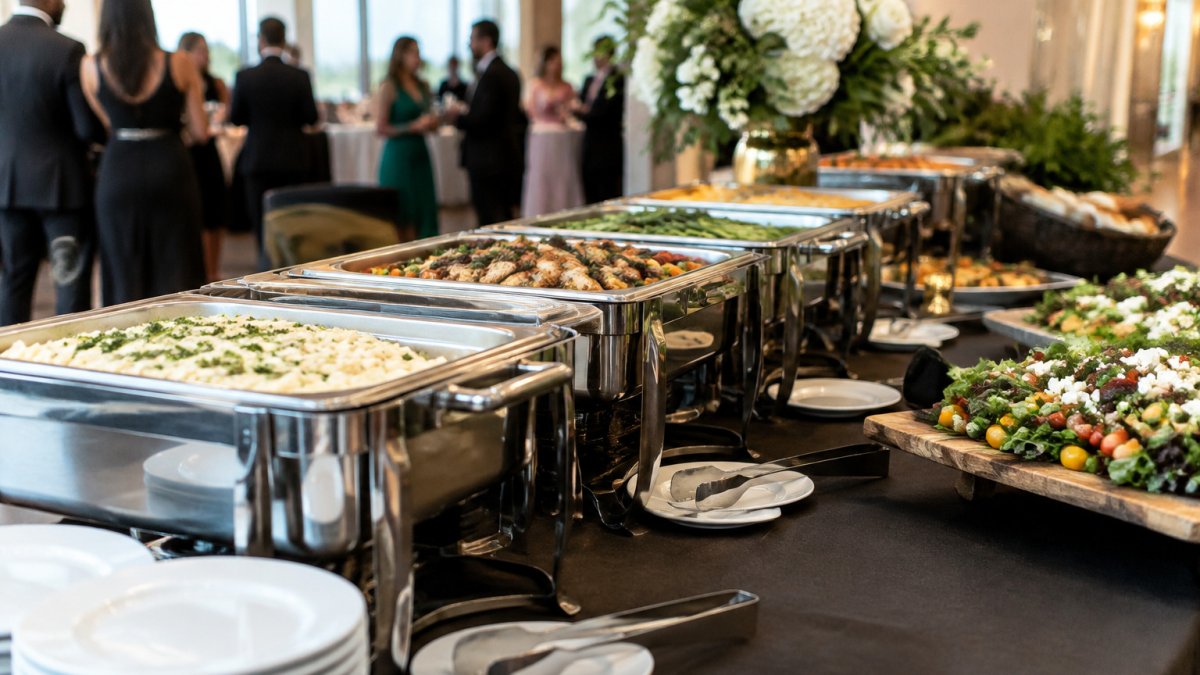
Choose service styles that fit. Family-style and buffet service often stretch a budget further than plated service while still showcasing seasonal ingredients.
Pro Tip Ask for a quote that separates food cost, labor, and logistics. A transparent breakdown lets you see where the farm-to-table premium sits and decide whether to spend it on produce, service, or presentation.
The practical concerns, addressed directly
The operational questions clients raise most often deserve direct answers:
"Can you guarantee the same menu if the date changes?" No, and a caterer who promises otherwise is either not sourcing seasonally or not being straight with you. A skilled caterer will offer an equally strong alternative menu built on what's excellent on the new date.
"What if a crop fails?" Weather, pests, and yield shortfalls happen. Good farm-to-table caterers maintain backup suppliers and build substitution flexibility into the contract. Ask how substitutions are handled and who decides.
"Can you handle dietary restrictions and allergies?" Yes, and direct producer relationships usually make it easier, because handling and ingredient origins are known rather than inferred. Ask for the specific protocol.
Watch Out Don't accept a farm-to-table label as a substitute for a clear quote, a substitution policy, and an allergen protocol. Those three documents tell you more about how an event will actually go than any sourcing claim.
The bottom line on cost
Farm-to-table catering is a premium approach, but it's a premium you can direct. Spend it on the ingredients guests taste, choose service styles that fit your budget, plan with the season rather than against it, and insist on a transparent quote and a clear substitution policy. Done that way, the cost difference is a choice about where to invest rather than an unavoidable markup.
Key Takeaway Farm-to-table catering usually costs more, but the premium is driven by identifiable variables, ingredient cost and yield, volume, seasonality, labor, and logistics, and it can be managed through produce prioritization, service style, waste reduction, and menu flexibility. Ask for a broken-out quote and a written substitution policy.
Frequently Asked Questions
What does farm-to-table catering mean?
Farm-to-table catering sources ingredients directly from local farms and producers, delivering them to your event with minimal time between harvest and service. This approach prioritizes fresh, seasonal produce and regional suppliers, reducing transportation distance and supporting local agriculture. For events, it means your guests receive peak-quality ingredients prepared by chefs who work closely with known farmers and suppliers.
What are the main benefits of farm-to-table catering for my event?
The primary benefits include superior flavor and freshness from ingredients harvested at peak ripeness, higher nutritional retention in produce that travels shorter distances, full traceability of your food sources for safety and quality assurance, and the ability to build a memorable guest experience around seasonal, locally grown ingredients. You also support local farms and reduce environmental impact through shorter supply chains and reduced food miles.
How does farm-to-table catering support local farmers and the community?
When caterers source directly from local farms, more food dollars stay within the regional economy. According to the USDA, agriculture and food-related industries contribute significantly to economic vitality, and local and regional food systems help keep spending in communities. Direct partnerships with farmers create stable demand, support agricultural viability, and strengthen the food system. This approach also builds relationships between chefs and growers, fostering a collaborative culinary movement.
Is farm-to-table catering more expensive than conventional catering?
Pricing depends on quantity, dates, delivery distance, and the specific sourcing practices your caterer uses. While some farm-to-table operations carry higher costs due to smaller-scale sourcing and direct farmer relationships, the investment reflects superior ingredient quality, freshness, traceability, and environmental responsibility. Many clients find the enhanced flavor, nutritional value, and guest experience justify the difference. Contact your caterer for a detailed quote tailored to your event.
Contact Us

Control is what I particularly love about Melon Sandbox because here I can place objects where I want them to be, arrange them as I see fit and check out whatever interactions I desire. If something fails to work, I can alter my approach and try something else – all of this allows me to experiment and come up with some pretty cool ideas.